With this new exhibition, Museum has new needs. Several options are available to partners who want to join either the exhibition or the museum, either one any of the competitions.
Silver Sponsorships You can donate money and obtain visibility on this website, but also in the video shown at the Museum (eg see the logo of Public-Land in the right margin). Amount to be discussed.
Cash Goods The museum needs new equipment for this exhibition. Each equipment will be clearly identified partner who offers • Plasma HDTV 46 " • DVD
Sponsorships photos For each exhibition, the museum needs photo enlargements which are wall mounted in the main hall and are identified partner. • Wall 28 ft x 8 ft from Side Films • Wall 12 'x 8' of Côté Jardin
Sponsorship Advertising To publicize the exhibition, the museum should buy advertising in the form of displaying, distributing door door across Sutton, in the local paper ... and even a car! • These costs are shared between several partners who are all identified in the advertisements concerned and on the website of the exhibition.
Sponsorships prizes for competitions This summer there will be two competitions for which merchants will offer prizes: • The Give Don : any visitor can make a donation to the museum exit. At the end of exposure, the winners win or lots provided by merchants. It can be objects or gift certificates. For example, for exposure of Ski Museum in Sutton , first prize was u No season pass for a person Sutton for the 2010-2011 season and second prize a ski jacket offered by Sport Expert. • Sutton Green : any new competition winner flower gardens of Sutton who will win a Evelyn Lambart Price reap the prices offered by merchants. For example, Max Gagne offers c ertificate for the rental of a tractor loader backhoe B26 for two days, including transportation - $ 450 value , Jardins Paquette offers a certificate of purchase $ 400 and Arbocom , tree maintenance service, offers a service certificate worth $ 350 .
For details, call Richard Leclerc at 450 538 2883 .
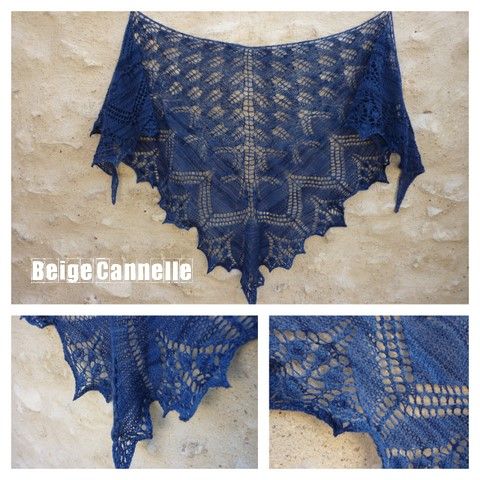
it's called ... but when I discovered his world through the competition "Creative Blog" mci, I was immediately charmed. A big big crush on her assemblies and materials " wood & co. (Incidentally, I took the opportunity to do a little spring cleaning in my links to the right ... exit addresses that no longer exist, replaced by new discoveries) .
It took me a few weeks - uh, months in fact - for emboldens me to ask if she would accept an exchange ... and my luck is that it has been like a needle lace!
100% merino wool "Shadow" from Knit Picks Jay Kettle Dyed
circular needles No. 3.5
I stung him his pictures, much prettier than mine. There are others at home, situations. There is rarely blue here, but it was right to choose that color, it look great.
Verdict: A really nice pattern to knit, and not boring at all because of the changing pattern. And it's not so bad, because I think I'm going to have me pick up soon ... there are two ladies who came for the weekend at home and have flashed well above! I have tried to offer them as gifts for Christmas, but small tricky reminded me that their birthday came before ...
And now that I know that Stephanie is in his studio to realize its "market share", I impatiently pawing ... I will quickly show you that!
Edict of 28/04/10: Caroline wonder if it also works without a bread machine ... could anyone tell him?! Because, my faith, I have no idea ... I never dared to get into the pulp removed before the machine, but I would say that a priori there is no reason, what do you think?
It never occurred to me is the idea of a Chinese house, until Celine that publishes photos of my faith very palatable ux what she had done ...
Inspired by the recipe and different variants Laetitia, I offer my personal version. The proportions are for two buns, it does not take much more time, and it freezes well.
Chinese Orange / Cinnamon
(for 2 pieces)
For the dough : Put the bread machine 130 ml of milk, 2 eggs omelette, 2 tablespoons of cream semi-thick 1 teaspoon salt , 110 g butter into small pieces, 110 g sugar powder, a hint of cinnamon powder, 550 grams of flour and a sachet of dried yeast . Launch the program dough from machine.
For the pastry cream: Meanwhile, heat 1 / 2 l milk (in book 1 / 2 glass) with 2 sticks of cinnamon . Let steep over low heat for about ten minutes. Mix two yolks ' eggs with 100g sugar , whisk until well ' that the mixture whitens. Add 50 g of flour and 1 / 2 glass of milk left, then pour the hot milk, stirring. Return to saucepan and bring to a boil, whisking. Cool. Cover the bottom of two cake pans with parchment paper.
To assemble: When the dough is ready, separate into two balls of equal weight. Roll out the first ball-shaped rectangle, spread with pastry cream and sprinkle with candied orange zest . Roll the dough into a sausage, cut sections and place in pan. Repeat with second dough. Let rise about 2 hours.
For the topping: Put in a small saucepan 2 tablespoons honey , 30 g butter and 3 0 g sugar . Bring to a boil and cook 1 minute. Pour half of glaze on each Chinese, and bake 30 minutes Th6 / 7.
Below the main stages of assembly, in photos:
I have already done 4 since I have this recipe ... with various fillings. Go check it out, there are plenty of other good ideas in Laetitia !
: Great Film Maker & Passionate Gardener from June 19 to August 15
First Female Animator, National Film Board of Canada
(1914-1999)
Source : Library & Archives Canada
Evelyn Lambart was born in Ottawa on July 23, 1914, one of four children of Howard and Helen (Wallbridge) Lambart. Hearing impaired from an early age, she credited the condition with focusing her interests on the visual world, and using it as a means of communication. She was given a steady supply of paint boxes, and encouraged to paint and draw. Her father, an avid photographer, also supplied her with cameras from a young age. She and her brothers and sister were raised with no preconceptions about what they could accomplish. As she said in an interview after her retirement, "the way I was brought up was to think of yourself as a person who had an obligation to use your talents in any way you could. Whether you were a woman or not didn't make any difference." (Munn, p. 64)
After attending Lisgar Collegiate Institute in Ottawa, Lambart's interest in art led her to study at the Ontario College of Art for five years, graduating in 1937. She had originally intended to further her studies in England after her graduation; however, the outbreak of the Second World War put a stop to that plan. She instead spent a year and a half working on illuminations and lettering for the first Book of Remembrance, housed at the Peace Tower in Ottawa.
Lambart's experience with the fine detail work required for the Book of Remembrance encouraged her to apply for a position at the National Film Board (NFB), then in Ottawa, where she began working in 1942. She began as a letterer but soon moved to creating maps, working on such films as Global Air Routes (1944) and Fortress Japan (1944) for the World in Action series. By 1947, Lambart was working on her first film, The Impossible Map . This was an examination of the difficulties inherent in trying to present proper images of world maps on flat surfaces. As funding was too scarce to purchase actual globes, she employed grapefruits with world maps painted on their surfaces as visual aids. Another film, Family Tree (1950), about Europeans in North America, was co-directed with George Dunning. She also did some work on segments for such films as Challenge: Science Against Cancer (1950), and The Fight: Science Against Cancer (1951).
It was around this time that Norman McLaren first approached her for assistance in drawing heraldic devices for one of his animated films. This marked the beginning of a working relationship that lasted into the late 1960s. Although he first approached her soon after she began her career at the NFB, it was not until 1949 that they truly began their collaboration, with the film Begone Dull Care . She worked with McLaren on a total of twelve films, including A Chairy Tale (1957), Short and Suite (1959), Lines: Horizontal (1961), Lines: Vertical (1962), and Mosaic (1965). Her participation in these works ranged from colour correction, to animating sections of the full work (as with Short and Suite ), suggesting ways of incorporating elements such as dust into the work (for Begone Dull Care ), and even physically manipulating the chair in A Chairy Tale . It was many years before she received full credit for the work she did with Norman McLaren. However, the strength and value of their collaboration was recognized in 1965, when Lambart was also honoured by a showing of films at the Annecy Film Festival celebrating McLaren's work.
By the early 1960s, McLaren was becoming increasingly interested in ballet films, something that held no interest for Lambart. She began to seriously contemplate working on her own. Although it took her some time and effort to become accustomed to working independently, and having the freedom to make her own creative decisions, in 1968 she produced her first solo animation effort, Fine Feathers . This film was followed by The Hoarder (1969), Paradise Lost (1970), The Story of Christmas (1973), Mr. Frog Went A-Courting (1974), The Lion and the Mouse (1976), and The Town Mouse and the Country Mouse (1980). The last two were produced as freelance works for the NFB after her retirement.
In contrast to the precise calculations and lines drawn directly onto film that were used while she was working with McLaren, Lambart told her stories using animated cut-outs. She began by working out the look of each character using shapes; facial features, bodies, and other parts that were cut from construction paper. Once she was satisfied with the basic form, she then cut the desired shapes from thin sheets of zinc, painting the details onto the metal. These figures were then manipulated against a black background to produce the story. She was able to make use of a brighter colour palette than that she used while working with McLaren, employing blues and reds rather than the cooler colours McLaren favoured. Even the stories she told with this technique were different. Instead of abstract concepts, Lambart preferred linear stories, particularly fables; many of her works involved animals.
After retiring from the NFB in 1975, Lambart purchased a piece of land in Sutton, Quebec, where she built a house of her own design. She continued to produce freelance work (including some for the NFB); she also pursued her interests in gardening, needlework, and other handicrafts. These efforts included the wall hangings that served as the awards at the 1982 Ottawa International Animation Festival. She also served as the honorary president of this festival in 1988. Evelyn Lambart died on April 3, 1999, at the age of 84.
Suggested Readings
ASIFA Canada . Vol. 15, no. 3 (January 1988). Issue is devoted to articles about Evelyn Lambart. Articles in French and English.
King, Annabelle. "Airy Studio Is Artist's Special Room." Montreal Gazette . (September 15, 1983), p. D1.
"Lambart, Evelyn Mary." In Canadian Who's Who . Edited by Kieran Simpson and Elizabeth Lumley. Toronto: University of Toronto Press, 1995. Vol. XXX (1995), p. 660.
Lee, Jerry. "The Job of Film Animator Still Very Exciting to Her After 19 Years at the NFB." Montreal Star . (May 27, 1961), p. 12.
Lee, Jerry. "Merging Film Artist and 'Constructor'." Montreal Gazette . (July 31, 1974), p. 35.
Mazurkewich, Karen. Cartoon Capers: The History of Canadian Animators . Toronto: McArthur and Company, 1999.
Mazurkewich, Karen. "Tribute to Eve Lambart." Take One . (Summer 1999), p. 52.
Munn, Felicity. "Creativity Heightened by Change in Career." Ottawa Citizen . (November 30, 1982), p. 64.
 With this new exhibition, Museum has new needs. Several options are available to partners who want to join either the exhibition or the museum, either one any of the competitions.